
A Hero is Born

On a map of Maharashtra, Bhagur is one of those numerous dots on the map that you just brush over. A typically sleepy, small town that you find scattered across the dusty, rocky plateau of Khandesh. If you still have some idea about the town, it would be more due to the adjoining Army cantonment at Deolali which is located right in the vicinity. The rather dry, rain fed Darna River, skits the edge of the town. On the face of it, this looks like any typical small town, you find in Maharashtra or Central Indian, homes with red tiled sloping roofs, narrow streets piled with rubbish, dogs and cows having a free movement in the narrow cramped lanes. The kind of town, where everyone knows each other, and where nothing actually happens for most of the time.
The other noticeable aspect of the town, is the Balakwade Gymnasium, an akhara of sorts, for aspiring body builders. Like most other towns in Maharashtra, Bhagur too is fiercely proud of it's connection with the Maratha Empire and Shivaji. And here it is through the Balakwade Gymnasium. Beyond the sounds of men grunting, puffing, as they lift the weights or do the push ups, this Gymnasium, does have a proud history of taking part in the Maratha Wars. Navji Balawkade who took part in the conquest of Sinhgad and Lohgad, Sardar Bhaoji Balakwade, Yesaji Balakwade who took part in the epic battle of Kazi Gadhi, and rescued Nashik from the clutches of the Mughals.
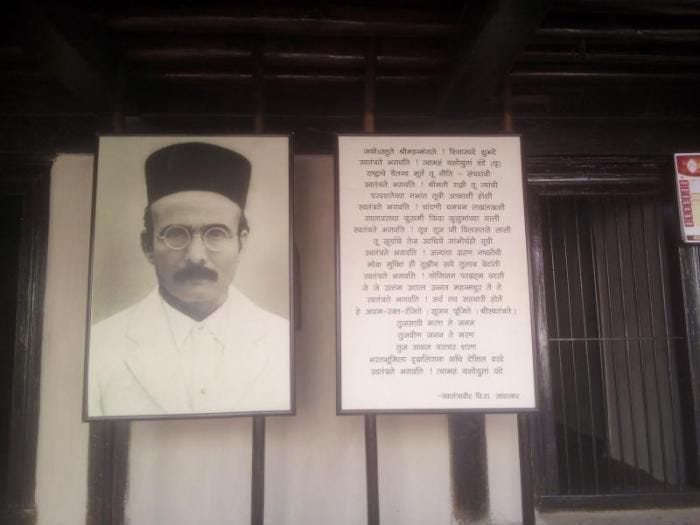
There would be nothing unremarkable though about the boy born on May 28, 1883. Vinayak Damodar Savarkar, better known as Veer Savarkar to many, was born on that auspicious date to Damodarpant Savarkar and Radhabai, the second of four children. Coincidentally the year in which he was born had seen, the passing away of two great icons of nationalism Swami Dayananda Saraswati and Vasudev Balwant Phadke.
Born as Mool Shankar in Gujarat, Swami Dayananda Saraswati, invigorated the sleeping Hindu masses with his clarion call of "Back to the Vedas". Leading a crusade against social evils, he urged Hindus to rediscover the roots of their glorious religion, and rise against the oppressive British rule. He founded the Arya Samaj, which would be a nursery of sorts for many a great freedom fighter like Lala Lajpat Rai, Bhagat Singh, Swami Shraddhanand from there. Vasudev Balwant Phadke who led the first major armed revolt against the British, passed away in a prison cell in Aden, pining for the freedom of his motherland.
He would combine the fierce, revolutionary zeal of Phadke, with Swami Dayananda's intelligence and exploration of Hinduism, to forge an identity of his own. He was a fierce fighter, and also a brilliant thinker and writer, who would forge a new ideology in Hindutva. Belonging to the Chitpavan Brahmin community, from where had emerged such greats like Bal Gangadhar Tilak, Phadke, Gopal Krishna Gokhale, as well as reformers like M.G.Ranade and D.K.Karve. As also the great Peshwas of Pune. It's believed that Parashuram, the sixth avatar of Vishnu, was searching for Brahmins, to do the penance ritual after his slaughter of the Kshatriyas. Finding no Brahmins, he found around fourteen bodies washed up on the sea shore, burnt them, breathed life into them, and bestowed the status of Brahmin on them. The fact that they emerged from the funeral pyre( Chita), and were purified by it( Pavan), made this their community's nomenclature.
To understand Savarkar more, however one needs to look into the context of the era when he was born. The year in which he was born was the one where Robert Louis Stevenson enthralled readers with a new adventure called Treasure Island.In the Indonesian archipelago, the Krakatoa volcano would erupt with a massive explosion, and the resulting tsunami would wipe out 163 villages and kill more than 38,000 people. Carlo Collodi would create a fictional character called Pinocchio, who emerged as a kid's favourite. It was discovered that Oxygen could be liquefied too.
Closer home though India, was at the cusp of a great social and political upheaval, with the 1857 Revolt crushed by the British, and most of the princely states ending up as their vassals. Savarkar incidentally called it the First War of Independence, and his book on it, was banned by the British Government as being too seditious. The crushing of the 1857 Revolt, meant that the British were now the sovereign masters of India.
It also meant they created a whole educated class, that believed anything Indian was inferior, and it was the Western civilization that was the greatest. Caught between a self-loathing, educated class, indifferent to the plight of her people, and the ordinary masses, who were drained of their spirit, energy, and had become a victim to casteism, superstition, ignorance, India was passing through her darkest phase. The British had physically destroyed India, ruined its economy, and worse had brainwashed a whole lot of people, into believing they were actually civilizing India.The educated classes had become slaves of the British rule, the masses were drained of spirit, and meekly accepted their oppression, putting it down to their destiny.
The darkest times, however often throw up some of the greatest heroes, and it was then during the late 19th century and early 20th century that the awakening took place. "Arise, Awake and Stop Not till the Goal is reached", thundered a young monk named Swami Vivekananda from Kolkata, and showcased the greatness of Hinduism to the West, and to fellow Indians. "Back to the Vedas" roared Swami Dayananda Saraswati, as he urged Hindus to go back to their roots and discover the greatness of their ancient civilization.
And inspired by the clarion call, Lokamanya Bal Gangadhar Tilak would defiantly proclaim "Swarajya is my birthright" . He would also begin the Sarvajanik Ganesh Utsav, to promote unity among Hindus, and ignite the spirit of nationalism. It was an era of nationalist awakening, of a consciousness arising among people of the glories of ancient India and Hinduism. It was an era that would lay the foundation for the nationalist movement, which would rise like a tidal wave against the entrenched British establishment. The spirit of India that was in slumber following the 1857 defeat, was awakening, and it needed more people to carry it forward.
Like most of the Chitpavan Brahmins, Savarkar's ancestors originally hailed from the Konkan region. During the Peshwa rule, they were one of the more prominent families, and also had the Jagirdari of Rahgur, a small village in Ahmednagar district. Known for their eminence in Sanskrit scholarship, his ancestors were widely respected and also enjoyed the honor of being carried in the palanquin.
His father Damodarpant, took pride in his roots, and the glorious past of ancient India. Stern and self respecting in nature, he was well built. Add to it he was gifted with a poetical talent, something his son would inherit later on, and excellent at striking up conversations.
His mother Radhabai was a pious and beautiful lady, with a tender heart. Vinayak was the second of four children, he had an elder brother Ganesh, a sister Mainabai and the youngest of them all Narayan.
His parents would recite several passages from the Mahabharat and Ramayan, as also the stories of Shivaji, Rana Pratap and the great Peshwas. His father was also a great admirer of Homer, and would often read the translation of Illiad to his sons. His mother would ensure his elder brother Ganesh "Babarao" would read out passages from the Ramayan and Mahabharath, every night without fail.
The stories of the great heroes, as also the moral values of the epics, left a deep impression on Vinayak's mind, and he would draw inspiration from them later in his life. He was sent to school at the age of six, where he began to show his genius. He was a voracious reader, and would intensely study any subject. Once when studying the history of Arabs, he asked his father about their early years. His father replied, that since the first pages of that book were torn off, that part was missing. Tatya wanted to know more about their antecedents, but could not. Later in his life, he concluded that the first pages of history were always missing, which would be a curse.
He was writing poems at an age of just ten years, and newspapers in Pune published them, not even knowing they were written by a small boy. An insatiable thirst for knowledge, an elephantine memory, a voice that impressed listeners, made Vinayak a remarkable personality. His father, was however startled by the fact that he was intelligent much beyond his years. For all his intelligence and knowledge, Tatya as he was affectionately called, was as normal as any school going child, full of mischief and who loved to play. He learnt archery,riding, and once even caught a snake with a piece of wire.
In June 1893, communal riots broke out in Azamgarh, Uttar Pradesh, between Hindus and Muslims, and later in Mumbai too. The reports of the atrocities of Muslims on Hindus reached Vinayak, who vowed to pay back, his blood boiling with anger. Leading a bunch of school mates, he attacked the local mosque, broke its windows, it was his initiation into direct action. The seeds of political activism and revolution were laid in him at that instant.
The Muslims though hit back, and although his group melted away, Tatya managed to beat them back with rolling pins, penknives, thorns. Soon he was training and organizing a group in the village. It was around this time that Vinayak moved to Nashik, which then was in the throes of a revolutionary movement. Tragedy struck, when his mother died of cholera , leaving his father to shoulder the burden. Tatya was just 10 years old, and his father often worked all day, shouldering the family burden, and attending to the children. By this time, he was fully fired up with the revolutionary ideals, all it needed was a spark to rouse him into action. And that spark would come from Pune, from a trio of brothers called Chapekar.